
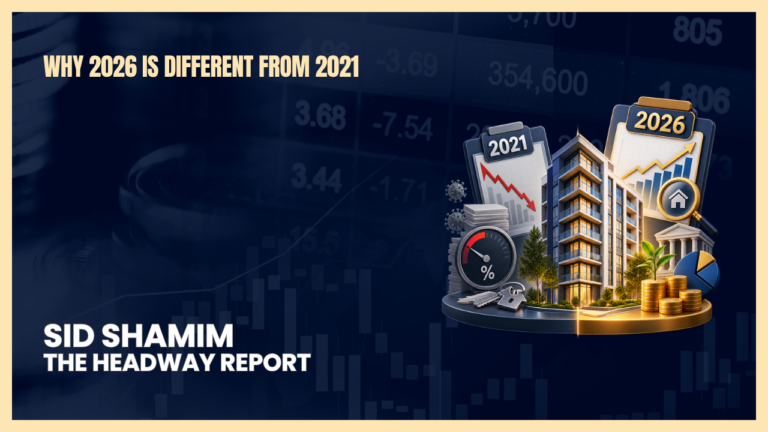
It is tempting to evaluate today’s real estate opportunities using the results investors experienced several years ago.
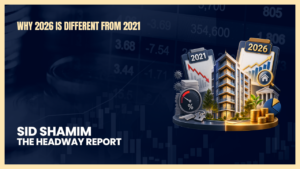
But the conditions that shaped the market in 2021 are very different from those influencing investment decisions in 2026.
Understanding that difference is essential because strategies that performed well in a low-rate, rapidly appreciating environment may not produce the same results today.
In 2021, Capital Was Extremely Inexpensive
Throughout 2021, the Federal Reserve maintained the federal funds target range at 0% to 0.25% while continuing to support financial markets through purchases of Treasury securities and agency mortgage-backed securities.
Residential mortgage rates also remained close to historic lows. For example, the average 30-year fixed mortgage rate was approximately 2.86% in August 2021.
Low borrowing costs increased purchasing power and allowed investors to finance properties at rates that made aggressive valuations appear more manageable.
Demand rose rapidly. By the fourth quarter of 2021, U.S. house prices had increased 17.5% year over year, according to the Federal Housing Finance Agency.
In commercial real estate, buyers frequently accepted historically low capitalization rates. Lower cap rates meant investors were paying higher prices relative to the income properties were producing.
In 2026, Financing Must Be Respected
As of July 29, 2026, the federal funds target range was 3.5% to 3.75%. The Federal Reserve also noted that inflation remained above its 2% objective and that economic uncertainty remained elevated.
The average 30-year fixed mortgage rate was 6.69% on August 6, 2026, compared with rates below 3% during portions of 2021.
Commercial loans are structured differently from residential mortgages, but the broader change in the cost of capital affects lender requirements, debt-service coverage, loan proceeds, and refinancing decisions across real estate.
A property that appeared comfortably leveraged with 2021 debt may produce very different cash flow when financed or refinanced at today’s rates.
Appreciation Is More Selective
In 2021, rapid appreciation allowed some investments to perform well even when their operating plans were imperfect.
That is a dangerous expectation to carry into 2026.
During the second quarter of 2026, the national median existing single-family home price increased 1.5% year over year. Prices rose in 80% of measured metro markets, but 20% experienced declines—demonstrating that performance has become more geographically uneven.
The commercial market has also experienced a valuation reset. The Federal Reserve reported that inflation-adjusted commercial real estate prices declined significantly between mid-2022 and early 2024 before showing signs of stabilization. Cap rates have recovered from their historical lows and are now closer to their long-term average.
Credit Conditions Are Improving—but Still Selective
The Federal Reserve’s July 2026 lending survey found that some banks had modestly eased standards for multifamily loans during the second quarter. However, overall demand for multifamily financing remained approximately unchanged, with stronger demand at large banks and weaker demand at smaller institutions.
This suggests that financing markets are functioning, but capital is not being distributed without scrutiny. Lenders continue to examine borrower strength, property performance, leverage, reserves,s and the credibility of the business plan.
What This Means for Investors
In 2021, investors could often benefit from:
- Low-cost financing
- Rapid rent and price growth
- Cap-rate compression
- Abundant liquidity
- Strong competition for assets
In 2026, successful investing is more likely to depend on:
- Purchasing at a defensible basis
- Using conservative leverage
- Generating income through operations
- Maintaining adequate reserves
- Selecting markets with durable demand
- Structuring debt around realistic cash flow
- Working with experienced operators
The Opportunity in 2026
A more difficult environment is not necessarily a bad environment.
Higher capital costs and slower appreciation can reduce competition, create motivated sellers, rs and expose properties that were financed too aggressively during the previous cycle.
The difference is that investors cannot rely on the market to rescue a weak investment.
In 2026, the operator must create value. The property must support its debt. The assumptions must be realistic. And the investment must still make sense without extraordinary appreciation.
In 2021, the market often rewarded speed. In 2026, it is more likely to reward discipline.
This material is for educational purposes only and does not constitute investment, legal, financial, or tax advice.