

Why Smart Investors Keep Choosing Real Estate Over Stocks
For many professionals, the traditional wealth formula has always sounded the same: work hard, save money, and invest in the stock market. For years, that path made sense. Public markets were accessible, simple, and widely trusted as the primary way to grow wealth.
But when you look closely at how long-term wealth is actually built, something interesting appears. The world’s most sophisticated investors—family offices, institutional funds, and private equity groups—do not rely on stocks alone. A significant portion of their portfolios is allocated to real assets, particularly commercial real estate.
The reason is simple: real estate offers characteristics that traditional investments often cannot. It produces income, provides meaningful tax advantages, and allows operators to create value through active management.
When investors buy stocks, they are purchasing a small share in a company they cannot influence. The leadership team decides the strategy, the market determines the valuation, and investors simply participate in the outcome. Real estate works very differently. Commercial properties are operating businesses. Apartment buildings house families. Medical office buildings support healthcare providers and essential services. These assets generate revenue through tenants and can often be improved through better operations, leasing strategies, and management.
In other words, investors are not just waiting for the market to move in their favor—they are participating in the performance of the asset itself.
Another reason experienced investors gravitate toward real estate is the ability to generate consistent income. Unlike many traditional investments that rely almost entirely on price appreciation, well-managed commercial properties can produce regular cash flow through rent payments. This income can then be distributed to investors as passive income while the underlying property continues to appreciate over time.
Tax efficiency is another major factor. The U.S. tax code strongly incentivizes investment into productive assets like housing and infrastructure. Through depreciation and other mechanisms, real estate investors are often able to reduce taxable income while still receiving distributions from their investments. For many high-income professionals, understanding these tax dynamics can dramatically change how they think about long-term wealth building.
Of course, real estate—like any investment—moves in cycles. The market environment we are experiencing today is very different from just a few years ago. Rising interest rates and tighter lending conditions have slowed transaction activity and forced many investors to step back from acquisitions. But historically, these types of environments often create the best opportunities for disciplined investors who are patient and selective.
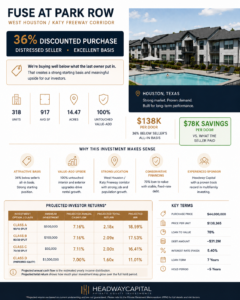
At Headway Capital, discipline has always been central to our investment philosophy. Over the past year alone, our team evaluated hundreds of multifamily opportunities across major markets in Texas and Arizona. Yet only a very small number met our underwriting standards. Our responsibility is not simply to acquire assets—it is to invest when the fundamentals make sense and when the risk-adjusted opportunity is truly compelling.
Beyond the financial aspects, we also believe real estate plays an important role in supporting communities. The United States continues to face a significant housing shortage, while demand for healthcare infrastructure remains strong. Apartments help provide housing for growing populations, while medical office buildings support essential services that communities depend on every day. These types of assets tend to remain resilient because they serve fundamental needs.
This newsletter was created to share a clearer perspective on what we are seeing in the market and how experienced investors think about commercial real estate. In future editions of The Headway Report, we will break down topics such as how real estate tax strategies work, how investors evaluate risk in a deal, and why disciplined operators sometimes pass on hundreds of opportunities before choosing the right investment.
Successful investing is rarely about chasing trends. More often, it comes down to understanding the fundamentals, staying patient during uncertain periods, and making thoughtful decisions when opportunities appear.